Interactive lessons help Lefler students become better readers
March 18, 2026
Lefler Middle School students like Aryos, A’mare and Abigail are refining their reading skills with an A-plus list of invigorating activities.
Seventh and eighth graders in a Rewards Plus Science class are improving their vocabulary, grammar and fluency with a host of research-based lessons. Lefler teacher Josh Haws is applying brain science research and pencil-and-paper materials to help many Lions become better readers. They have increased their test scores, gained more confidence and become more engaged in their education.
Abigail and A’mare both said they look forward to spending time in class each school day. They have learned how to identify and write topic sentences, put punctuation marks in the proper places and spell dozens of new words and phrases.
“It makes me feel good about myself,” Abigail said. “I wasn’t a good reader before, so for Mr. Haws to teach me things like that, it was like, ‘Wow, this is working.’ I could see that he really helped me.”
“I’ve been reading more and doing it a lot faster compared to fifth and sixth grade,” A’mare said. “It feels really good.”


Haws said his top goal is to help the Lions have a good experience in class. He praises students when he sees them achieving goals, designs interactive lessons for them and incorporates printed materials to stimulate their brains. Those actions create an environment where everyone can flourish academically.
“The best part of being a teacher is seeing a student gain confidence in their skills and understand concepts for the first time,” Haws said. “With each success, they see themselves as capable, and they start to attach agency to their growth.”
Haws said one of his core strategies is providing students with opportunities to respond (OTR) in class. He creates partner-based activities, calls on individual Lions to answer questions and asks them for suggestions on topics for new sentences. The OTR lessons help them connect familiar concepts to new ideas through repeated practice, and they increase the amount of prosocial learning that happens in class.
“Student participation is vital, because nobody learns through passively sitting in a chair,” Haws said. “They need to say and write new words, participate in group and whole-class activities, and take an active role in every aspect of class. Some students do this naturally, but it’s the teacher’s job to work active strategies into every lesson, even something as simple as having students repeat a word after you. The kids who participate are the kids who learn.”
During one activity this winter, each student received cards that included portions of different sentences on them. They then mingled with classmates to locate the matching pieces of their phrases. After pairing up, they used magnets to place their complete sentences on a whiteboard for everyone to read.
Aryos and A’mare then played leading roles in another interactive lesson. Haws provided them with paper copies of commas that had magnets attached to them. He then placed snippets of sentences up on a whiteboard for the class to read. Aryos and A’mare went to the front of the room and placed commas in the correct spots of each sentence.
“It’s pretty fun to do things like that, because you don’t always have to stay in your seat,” Aryos said. “You can move around, and I think that helps me learn.”
“It was fun,” A’mare said. “I definitely liked getting up and putting the commas on the board.”


Handheld tools are another key component of the class. Haws uses flashcards, workbooks, index cards, word scramble activities, response cards and magnetized punctuation for his lessons. Students also write words, sentences and paragraphs on paper instead of typing them on computers.
Haws said he has watched the Lions benefit in many ways from that approach. Researchers from schools such as Indiana University have indicated that handwriting improves complex motor skills, leads to longer-lasting recognition of letters and improves the memory and recall of words.
“There are some interesting studies that show physical writing with pencil and paper is more effective at helping students learn than typing on a computer,” Haws said. “Although I certainly use technology tools, I also try to incorporate paper-and-pencil activities frequently, and I really do see students being more engaged academically than when their computer is open.”
Abigail said she has noticed a difference in her reading comprehension this year. She has learned how to recognize complex words and write detailed sentences about many science subjects. She was excited when a timed test confirmed what she had been feeling.
“My test scores went up,” Abigail said. “He gave me a test of seeing how many words I could read in a minute, and he saw I improved in reading for a time. I think I got better at that with Mr. Haws’ help.”
Haws said he wants every Lion to have the same enriching experiences as Aryos, A’mare and Abigail when they walk into his classroom.
“We have to make learning exciting for 12-, 13- and 14-year-olds and help them find the motivation to try new things,” Haws said. “I truly believe that all of my students can successfully master the objectives of this class, and it is my job to teach them in a way that is effective and engaging.”
Empowering every reader is fundamental to lifelong learning. Discover more about the LPS English Language Arts curriculum for middle and high school.
Do you have a story idea? Share it with the LPS Communications Team by filling out this form!
Published: March 18, 2026, Updated: March 18, 2026
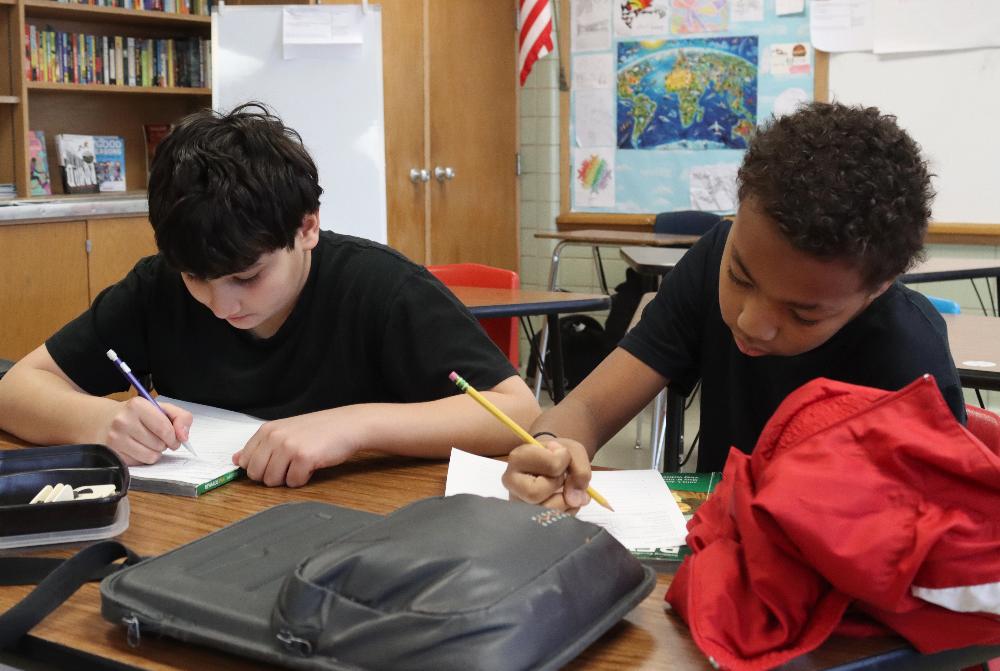
From left, Lefler Middle School students Aryos and A'mare practice their writing skills in a Rewards Plus Science class. The course is helping students improve their vocabulary, grammar and fluency by applying brain science research.